

In Tibetan Buddhist monasteries, many young lamas (child monks) receive religious education instead of attending secular schools. However, this does not mean they receive no education. Tibetan Buddhism provides a structured learning system that focuses on religious studies while also incorporating cultural and practical knowledge.

Young lamas primarily study Buddhist scriptures, doctrines, and rituals, including:
• Reciting and studying Buddhist texts (such as the Kangyur and Tengyur)
• Learning Tibetan script (including reading and writing)
• Participating in Buddhist debate training (a unique method in Tibetan Buddhism to develop logical thinking)
• Chanting, meditation, and religious practices

Many monasteries teach Tibetan, Sanskrit, and sometimes Chinese or English to facilitate communication with the outside world.
Larger monasteries may offer basic subjects such as mathematics, history, and geography to supplement traditional Buddhist studies.

Young lamas also learn traditional Tibetan arts and crafts, such as butter sculpture, Thangka painting, wood carving, and Tibetan medicine.
They participate in daily monastery chores, such as cleaning, cooking, and preparing for religious ceremonies, to develop self-discipline and life skills.
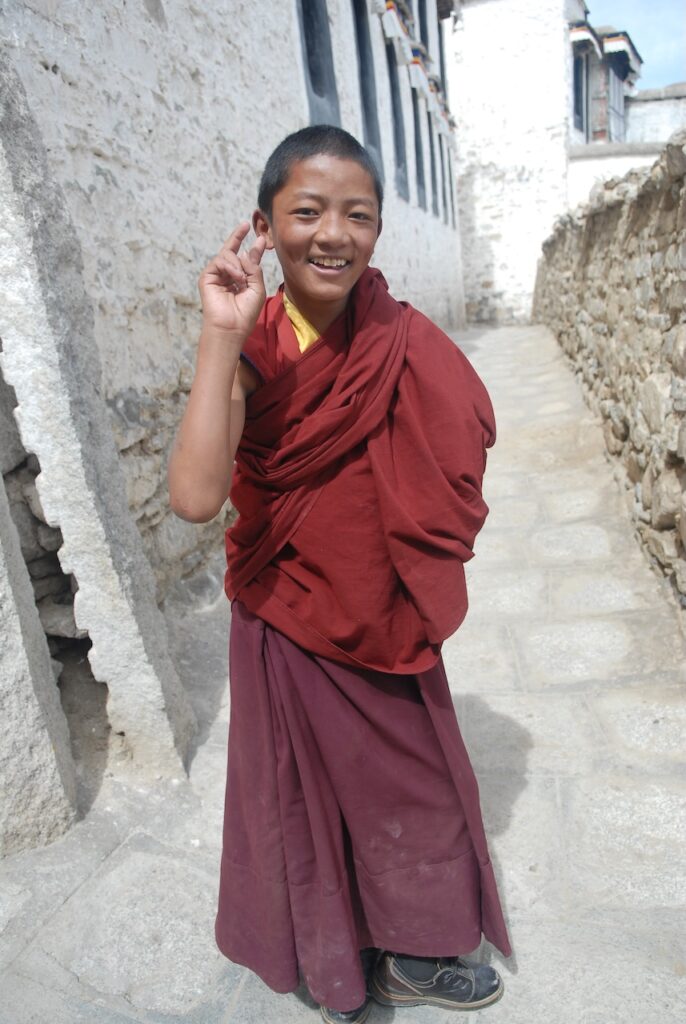
Why Don’t They Attend Regular Schools?
• Many young lamas voluntarily join the monastery or are sent by their families, where they receive structured religious education instead of secular schooling.
• In the past, access to public education in Tibetan regions was limited, and monasteries provided a means for children to receive an education.
• Today, some government policies encourage monasteries to offer broader educational curricula, allowing young lamas to gain a more comprehensive knowledge base.

The Chinese government’s promotion of Mandarin within the Tibetan Buddhist system has indeed impacted the education and cultural inheritance of young lamas. Tibetan is the core language of Tibetan Buddhist scriptures and teachings, with most Buddhist texts, debates, and religious rituals passed down in Tibetan. However, the widespread use of Mandarin may weaken young lamas’ proficiency in Tibetan, affecting their understanding of Buddhist scriptures and their ability to engage in religious discussions. In some monasteries, the proportion of Tibetan language courses may be reduced, leading young monks to rely more on Mandarin for communication, which in turn diminishes their ability to read and write in Tibetan.
Furthermore, the emphasis on Mandarin education has led to a reduction in the time allocated to religious studies in some Tibetan monasteries, potentially compromising the integrity of traditional Buddhist education. Some Buddhist academies, under policy requirements, have incorporated more Mandarin-based instruction while reducing the depth of classical Buddhist teachings, affecting the systematic transmission of religious knowledge. The shift in language use may also influence cultural identity, as Tibetan Buddhism traditionally relies on oral transmission between masters and disciples in Tibetan. The increased use of Mandarin could weaken this tradition, leading to a gradual decline in young lamas’ sense of connection to Tibetan Buddhist culture, religious rituals, and local customs.
However, the promotion of Mandarin also provides young lamas with greater access to modern knowledge and opportunities for social development. It enables them to better understand national policies, legal systems, and engage in broader cultural exchanges. If a balance can be struck between Mandarin education and the preservation of traditional Tibetan Buddhist education—ensuring that young monks acquire the linguistic skills necessary for modern society while maintaining their connection to Tibetan Buddhist traditions—this change could offer new opportunities for adaptation. However, if the promotion of Mandarin comes at the cost of weakening Tibetan language and Buddhist education, the loss of traditional culture could become a significant concern. Therefore, finding a way to promote Mandarin while safeguarding Tibetan Buddhist heritage remains a long-term challenge.
The introduction text comes from Wiki&Baidu
Photo By Clint & Wilson