
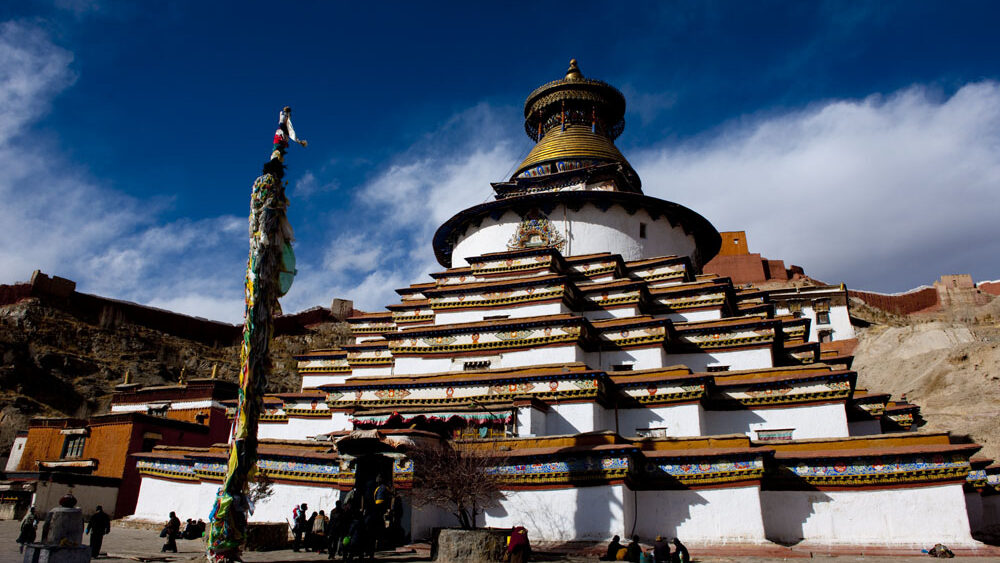
The Palcho Monastery or Pelkor Chode Monastery or Shekar Gyantse is the main monastery in the Nyangchu river valley in Gyantse, Gyantse County, Shigatse Prefecture, Tibet Autonomous Region. The monastery precinct is a complex of structures which, apart from the Tsuklakhang Monastery, also includes its Kumbum, believed to be the largest such structure in Tibet,that is most notable for its 108 chapels in its several floors and the old Dzong or fort.
The earliest history of the Penchor Chode Monastery is traced to the ninth century. Pelkhor-tsen, son of Langdarma (anti Buddhist King of West Tibet) after whom the monastery is named as Pelkor Chode, lived here and attempted to perpetuate the Yarlung dynasty of his father who had been assassinated.[5] The town of Gyantse was established between the 14th and 15th centuries as a feudatory, with the Sakya sect playing a crucial overlord role. During this period, the Buddhist monuments were also built with the Dzong (the old fort) followed by the Kumbum and the Pekor monastery. All three structures have been dated. Tsuklakhang monastery was built by prince Rabton Kunzang Phak between 1418 and 1425. However, Gyantse’s historical importance declined by the end of the 15th century.
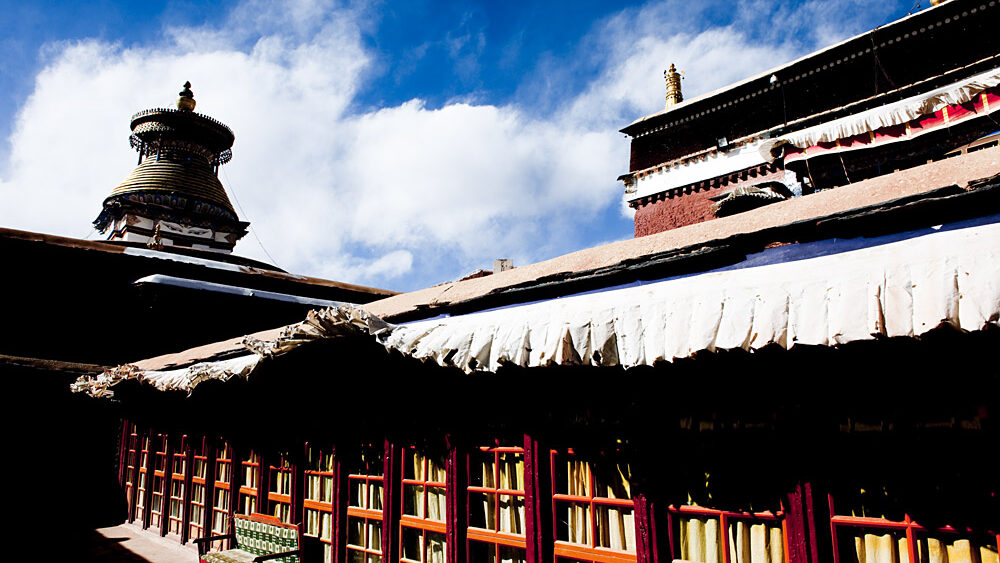
The Tsuklakhang, the main temple of the monastery was built in 1418–1428 by Rabten Kunzang Phak, the second Prince of Gyantse, who was a devotee of Kedrub Je (1385–1438), one of Tsongkapa‘s leading disciples later recognized as the 1st Panchen Lama. It became an important centre of the Sakya sect of Tibetan Buddhism. The Kumbum or Tashigomang, commenced construction in 1427 and completed by 1437, also by prince Rabten Kunzang Phak. Several other buildings followed, with Buddhist sects such as Sakyapa, Zhalupa and Gelukpa building religious colleges or hermitages; 16 colleges were recorded by the end of 17th century, increasing to 18 by the start of the 19th century. However most of them were later closed. Now, only two colleges of the Gelukpa order remain, which are stated to be of little consequence.Another testament to Prince Rabten Kunzang Phak’s period is the public display of two gigantic paintings; (Thangkas) of Shakyamuni Buddha flanked by his two principal disciples, of Maitreya, Manjushri and many more on the occasion of the Gyantse festival that is held in the fourth lunar month of the Tibetan calendar. This practice was started between 1418 and 1419 in the northeast corner of the monastery walls, known as Goku Tramsa.
In 1904, the British expedition to Tibet led by Colonel Francis Younghusband reached Gyantse on 11 April. The town’s garrison had already fled, and the expedition’s members entered the town bloodlessly through the front gates, which were opened for them, and occupied Gyantse. After the town was occupied, several British officers visited the monastery and seized several statues and scrolls, some of which were subsequently brought back to the United Kingdom.The monastery was partially destroyed by Chinese forces in 1959 after the 1959 Tibetan uprising. It was ransacked again during the Cultural Revolution, but has since been largely restored.Prior to the uprising there were 1,520 monks at the monastery[11] but now they number less than 80.
Kumbum has nine floors or tiers and each tier has unique chapels. The 76 chapels have images that form “a progressive hierarchy of three-dimensional manadalas, as outlined in the Sakyapa compilation known as the Drubtob Gyatsa, ensuring that the stupa encapsulates within it the entire spiritual path and gradation of the tantras”.
The first tier of the Kumbum has staircases at the cardinal points which lead to the second tier, with the main entrance being that from the southern side. The second tier has 20 chapels which house images of Kriyatantras in a clockwise order. The third tier has 16 chapels and also depicts images of Kriyatantras along with Caryatantras, arranged in a clockwise order. In the fourth tier, there are twenty chapels depicting images of Yogatantras in a clockwise order. The fifth tier has 12 chapels depicting lineage holders. In the sixth tier there are four chapels, which show Yogatantra deities. The seventh tier has a single chapel with 10 mandalas, a unique depiction of the “Father Class of Unsurpassed Yogatantras”. The eighth tier has also a single chapel but depicts 11 mandalas of “Mother Class of Unsurpassed Yogatantras”. The last and tenth tier has a single chapel, which has an idol of the Vajradhara Buddha but is “flanked by the masters of the Kalachakra“.
Gyantse Fort or Gyantse Dzong (Jiangzi Dzong) built on the rugged hills surrounding the Gyantze town (once the third largest town in Tibet) has an arresting presence behind the town. The fortress is dated to 1268 and a castle was also built inside by local Prince Phakpa Pelzangpo (1318–1370) who was influential with the Sakyapa overlords. Buddhist guru Butan Rinchen Drub of Zhalu resided here at the invitation of the prince and made it his religious seat. Later, in the 14th century, the palace was moved from the fort to the Gyantse town where Kunga Phakpa had built a larger complex of buildings and monasteries. During this period, he also built a temple on the hill top called the Sampel Rinchenling. However, this is seen only in ruins now except for some murals made in genuine Newari and Gyantse Tibetan styles.
*The introduction text comes from Wiki
*Photo By Clint & Wilson