
Tibetan dialects (also known as Tibetan languages) refer to the various spoken forms of modern Tibetan and constitute a branch of the Tibeto-Burman language family.
There are multiple classification schemes for Tibetan dialects. The differences among them are significant—so much so that the three major dialects are mutually unintelligible and can be considered separate languages. Ethnologue lists over fifty languages under the Tibetan umbrella.
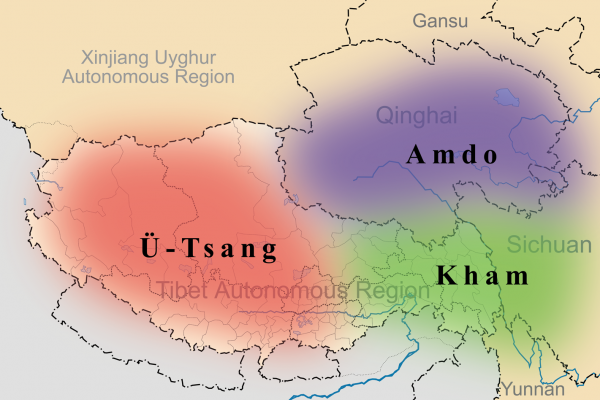
The Ü-Tsang, Kham, and Amdo dialects are the most widely spoken and are collectively known as the three major Tibetan dialects.
According to Tournadre (2014), Tibetan comprises around 50 distinct languages, which can be further divided into more than 200 dialects or grouped into several dialect continua.
Linguistic differences in the northern and eastern regions are relatively pronounced, possibly due to contact with Qiang and Gyarong languages. The divergence of Khams Tibetan in the Kalong area may also be attributed to language shift. Additionally, the Baima language retains a clear Qiang substratum and has repeatedly borrowed from Amdo, Khams, and Central Tibetan varieties, yet it does not belong to any established branch of the Tibetan language group.
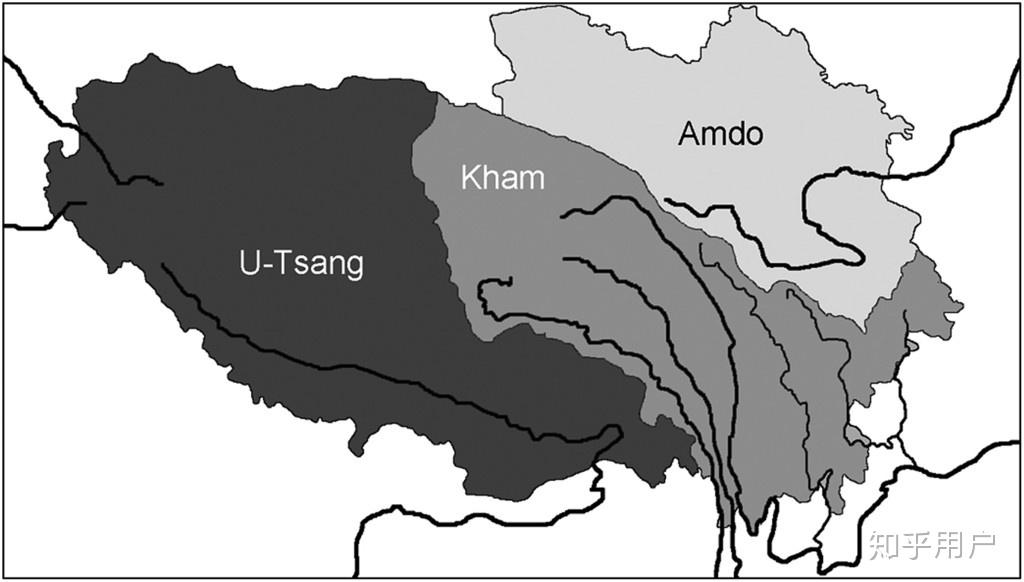
According to Zhu Aitang and Tan Kerang (1981), the classification of Tibetan dialects within China is as follows:
Ü-Tsang Dialects
These are spoken in most areas of Tibet, except for Chamdo Prefecture, Nagqu Prefecture, Nyingchi County of Nyingchi Prefecture, and parts of Ngari Prefecture.
- Front Ü-Tsang dialects (e.g., Lhasa dialect)
- Back Ü-Tsang dialects (e.g., Shigatse dialect)
- Ngari dialects (e.g., Gar dialect)
In a later study (1983), Zhu and Tan further classified the Ngari dialects:
- Gar, Rutog, Burang, and Zanda dialects belong to the Front Ü-Tsang group
- Geji and Cuoqin dialects belong to the Back Ü-Tsang group
- The Gaize dialect is considered part of the Kham dialect group
Kham Dialects
These are mainly spoken in:
- Chamdo Prefecture, Nagqu Prefecture, and Nyingchi County of Nyingchi Prefecture in Tibet
- Parts of Ngari Prefecture
- Garzê Tibetan Autonomous Prefecture in Sichuan
- Diqing Tibetan Autonomous Prefecture in Yunnan
- Yushu Tibetan Autonomous Prefecture in Qinghai
Examples include:
- Dege dialect (Garzê, Sichuan), such as Chamdo and Garzê dialects
- Yushu Tibetan, such as the Jiegu dialect
- Yunnan Tibetan, such as the Zhongdian dialect (Diqing, Yunnan)
- Xiangcheng dialect (Garzê, Sichuan)
- Heihe dialect (Nagqu), such as the Gaize dialect
- Zhuoni dialect (Gannan Tibetan Autonomous Prefecture, Gansu)
- Zhouqu dialect (Gannan, Gansu)
Additionally, Gesang Jumian (1985) proposed dividing the Kham dialects into four regional groups:
- Southern route dialects
- Northern route dialects
- Central route dialects
- Nomadic area dialects The relationship between these groupings and the subgroups proposed by Zhu Aitang and Jin Peng remains unclear.
Amdo Dialects
These are primarily spoken in:
- Tibetan autonomous prefectures and counties in Gansu and Qinghai
- Parts of Hualong Hui Autonomous County and Xunhua Salar Autonomous County in Haibei, Qinghai
- Parts of Aba Tibetan Autonomous Prefecture in Sichuan
Examples include:
- Nomadic area dialects: Alike dialect (Haibei, Qinghai), Zeku dialect (Huangnan, Qinghai)
- Agricultural area dialects: Hualong dialect, Ledu dialect (Haidong, Qinghai), Xunhua dialect
- Semi-agricultural/semi-nomadic dialects: Xiahe dialect (Gannan, Gansu)
- Daofu and Luhuo dialects (Garzê, Sichuan)
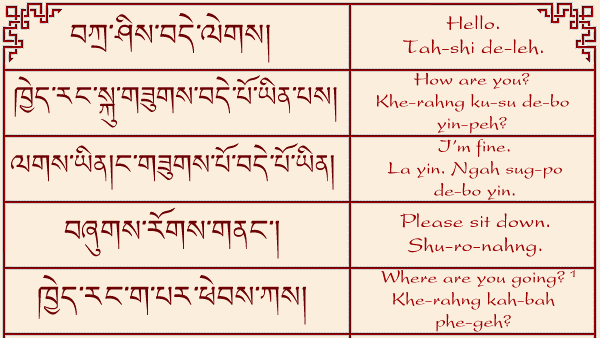
The Tibetan people represent a vast and culturally rich ethnic group, distinguished by diverse scripts, clothing styles, and dialects across regions. Collectively, Tibetan culture is not only a vital part of Chinese civilization but also an irreplaceable element of global cultural diversity.
Among these cultural elements, language stands out as both the most fragile and the most essential. It carries historical memory, ethnic identity, and the threads of generational continuity. While promoting a common language to enhance communication is a natural outcome of modernization and globalization, it is equally important for local and central governments to actively encourage the use of regional dialects and implement effective measures for their preservation.
Cultural protection should not be limited to museum displays or digital archives—it must be embedded in everyday life. Only through continued use and organic transmission can these languages and traditions truly thrive, allowing this precious heritage to flourish in the modern era.
The introduction text and photo comes from Web
Edited by Clint & Wilson