
The Tibetan language, known as “Bod skad” in its native form, is a member of the Tibeto-Burman branch of the Sino-Tibetan language family. It is spoken primarily in Tibet, parts of northern India (such as Ladakh and Sikkim), Nepal, and Bhutan. Tibetan is not only a means of daily communication but also a sacred language in Tibetan Buddhism, with a long tradition of religious and philosophical literature.
The Tibetan Writing System
The Tibetan script was developed in the 7th century CE during the reign of King Songtsen Gampo. It is an alphabetic script derived from the ancient Indian Brahmi script, particularly through the Gupta script. Tibetan is written horizontally from left to right.
The script consists of:
30 root consonants
4 vowel symbols (inherent “a”, and diacritics for “i”, “u”, “e”, and “o”)
Subjoined and superscribed consonants used to create clusters
Various punctuation marks and special symbols
The 30 Tibetan Root Consonants
The Tibetan script has 30 base or root consonants, which form the foundation of its phonetic system. These consonants are:
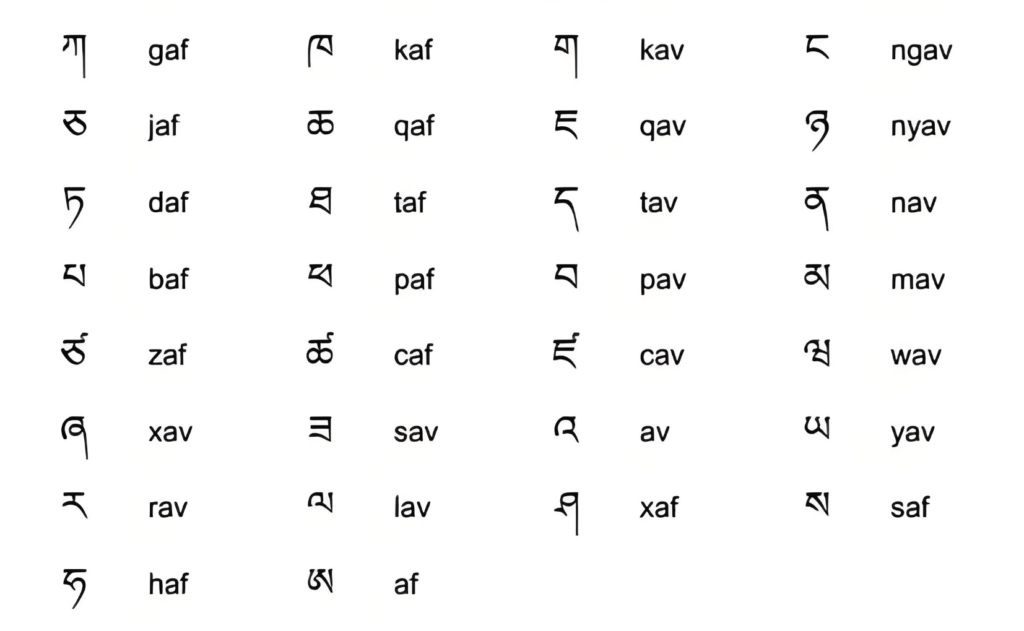
These consonants are arranged in a traditional order based on phonetic principles, somewhat similar to the Sanskrit alphabet. Some of these consonants can take subjoined forms, and several can appear above or below the root to form consonant stacks, which are a key feature of Tibetan orthography.
Grammatical Features
Tibetan is a verb-final language, with a Subject-Object-Verb (SOV) word order. It employs a system of particles to indicate grammatical relationships and sentence types. There is also a significant distinction between spoken Tibetan dialects (like Lhasa Tibetan, Amdo, and Kham) and the classical literary Tibetan, which is used in scripture and formal writing.
Conclusion
Learning the 30 root consonants is the first step in mastering the Tibetan language. Understanding the script and the way consonants interact within syllables opens the door to reading Tibetan texts, especially the vast Buddhist canon. The Tibetan language is a vital carrier of Tibetan culture, religion, and identity, and its preservation is essential for maintaining this rich heritage.