

Regarding the Agreement of the Central People’s Government and the Local Government of Tibet on Measures for the Peaceful Liberation of Tibet signed in 1951 (commonly known as the “Seventeen-Point Agreement”), it has consistently been a core issue fraught with immense controversy and multiple narratives within the fields of history, political science, and the international community.
Describing it as “a shackle binding the Tibetan people” primarily reflects the perspectives of Tibetan exiles, mainstream Western academics, and human rights organizations. Conversely, official Chinese narratives view it as a historic milestone marking the “peaceful liberation of Tibet” and its liberation from the constraints of foreign imperialism.
To comprehensively analyze this agreement and its subsequent impact, we can examine it through the following core dimensions:
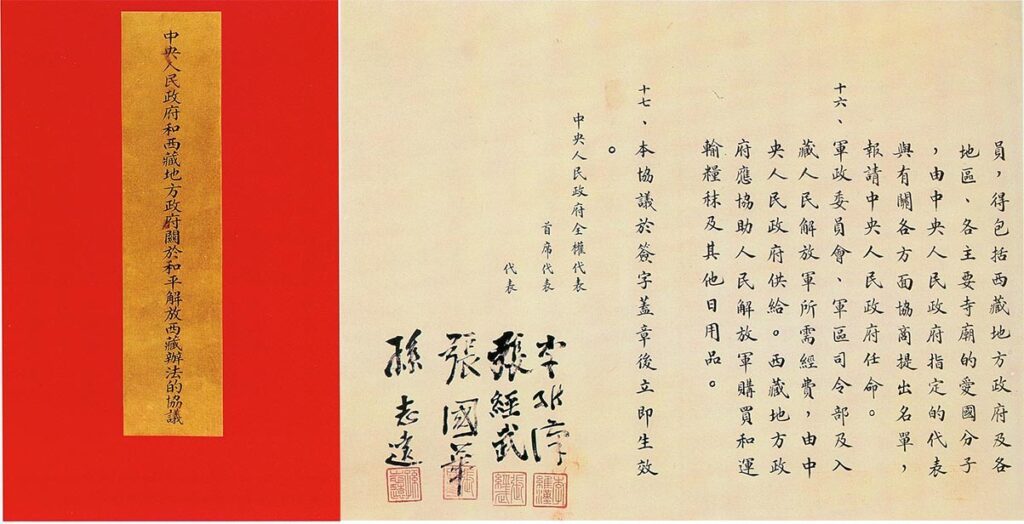
I. Signing Background and the “Unequal Treaty” Controversy
Critics argue that the agreement was signed under military threat and coercion, thereby lacking legitimacy under international law.
Military Pressure: In October 1950, the Chinese People’s Liberation Army (PLA) launched the Chamdo Campaign, defeating the Tibetan local army. It was under this immense “city-under-siege” military pressure that the Tibetan delegation traveled to Beijing for negotiations.
Authorization and Seal Issues: According to the Dalai Lama’s autobiography and accounts from Tibetan delegates, the negotiators at the time were not granted final, plenipotentiary authorization by the Tibetan government in Lhasa. The Tibetan delegates even claimed that the official seals of Tibet used on the agreement were forged by Beijing and that they were forced to affix them.
The Meaning of the “Shackle”: From this perspective, the agreement was not a treaty between equals, but rather a political tool used by Beijing to impose its sovereign will on Tibet, thereby bringing Tibet under the administrative and military control of the People’s Republic of China.
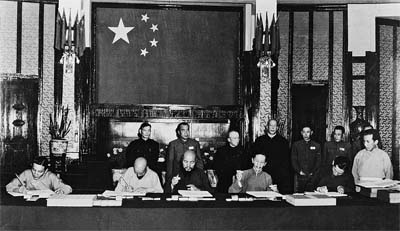
II. Agreement Content and the Prototype of “One Country, Two Systems”
From the text itself, the Seventeen-Point Agreement was actually an early experiment with the modern concept of “One Country, Two Systems.” Its clauses simultaneously established the absolute authority of the Central Government while promising to protect Tibet’s existing systems:
Central Authority (Establishment of the Shackle): The agreement explicitly stated that Tibet is a part of Chinese territory; Tibet’s foreign affairs and national defense were to be centrally managed by the Central Government; and the Tibetan army was to be progressively reorganized into the PLA.
Autonomy Commitments (Conditions of Mitigation): Concurrently, the Central Government promised not to alter Tibet’s existing political system, not to alter the inherent status and authority of the Dalai Lama and the Panchen Erdeni, and to respect Tibet’s religious beliefs and customs. Furthermore, local reforms were to be based on the principle of “voluntariness” without coercion.
This duality led to subsequent conflicts: the Central Government believed the agreement granted it the legal authority to enter and transform Tibet, whereas the Tibetan upper class viewed the agreement as a “protective talisman” to preserve Tibet’s high degree of autonomy and traditional social structure.
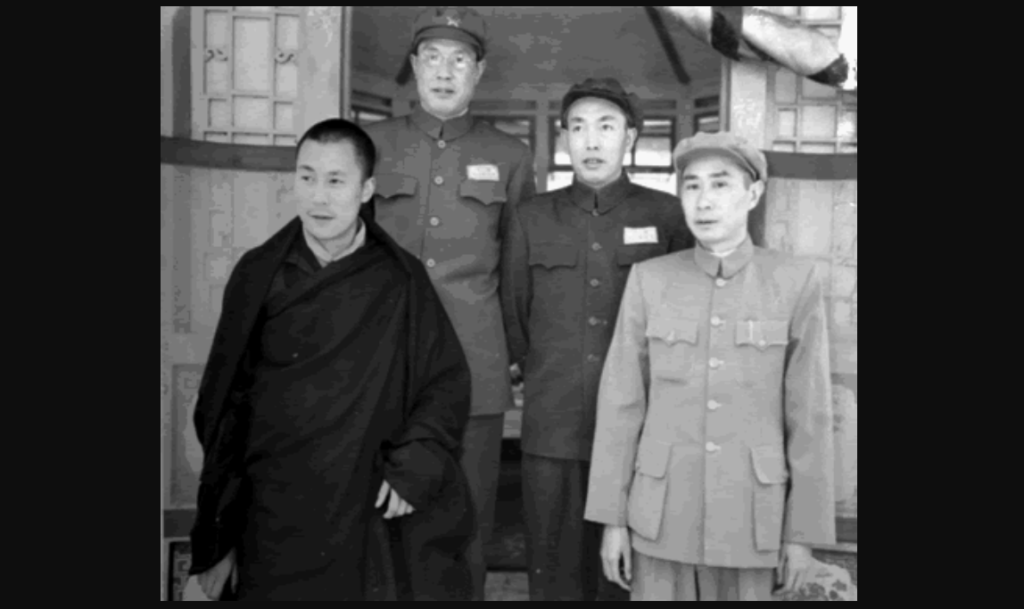
III. The Fracturing of Implementation and Ultimate Nullification (1951–1959)
Following the signing of the agreement, mutual trust failed to materialize, ultimately leading to a complete collapse in 1959:
“Democratic Reforms” in Surrounding Tibetan Areas: Although the agreement stipulated that no immediate reforms would be implemented within Tibet proper, the Chinese government forcefully pushed forward land reform and class struggle in the mid-1950s across Tibetan areas in neighboring provinces (Kham and Amdo, located in Sichuan, Qinghai, Gansu, and Yunnan). This triggered armed resistance, causing a massive influx of refugees and resistance forces into Lhasa.
Conflict Between Sovereignty and Autonomy: As the PLA stationed itself in Lhasa and various strategic locations, the traditional Tibetan government (the Kashag) found its authority increasingly marginalized. For Tibetans, this validated the prophecy that “the agreement is a shackle,” as their traditional religion and social order faced a comprehensive purge.
The 1959 Lhasa Uprising: Contradictions culminated in a total explosion in March 1959, triggering large-scale armed conflict. The Dalai Lama subsequently fled into exile in India. Upon his arrival, he formally declared the Seventeen-Point Agreement null and void, citing that Beijing was the first to violate its commitment not to alter Tibet’s systems. The Chinese government then announced the dissolution of the Kashag government and implemented full-scale socialist transformation.
Viewing the Seventeen-Point Agreement as “a shackle binding the Tibetan people” is a stance rooted in national self-determination, geopolitical independence, and the preservation of traditional religious culture. From this perspective, the agreement served as a legal and military tether that terminated Tibet’s de facto independence and paved the way for subsequent political campaigns and cultural suppression.
The photos come from Google
Edited by Wilson & Clint