

Throughout the centuries of Tibetan Buddhism’s evolution, the reincarnation of high lamas (tulkus) has been a supreme, sacred ritual concerning the “search for the soul,” karmic vows, and deep religious faith. However, as the 14th Dalai Lama advances in age, the power vacuum left by his impending reincarnation has drawn intense global attention. In recent years, the Chinese government has repeatedly asserted that the future 15th Dalai Lama must be chosen through the “Golden Urn Lottery” and approved by the central government to be valid.
This inevitably prompts a series of questions: What exactly is this “Golden Urn” system that Beijing treats as an absolute gospel? Why is a secular government so obsessed with a religious ritual? And does it possess genuine legitimacy and orthodoxy within a true religious and historical context?
What is the Golden Urn Lottery?
Simply put, the “Golden Urn Lottery” is an administrative procedure established in Tibet in 1792 (the 57th year of Emperor Qianlong’s reign during the Qing Dynasty) to determine the reincarnation of high lamas through a lottery draw. Upon the passing of a grand lama, the names of several selected candidate children are written on ivory slips and placed inside a golden urn (the Golden Benba Vase) bestowed by the Qing court. The final choice is determined by a draw conducted jointly by the Qing Imperial Resident (Amban) and high-ranking monks in front of the statue of Shakyamuni Buddha in the Jokhang Temple.
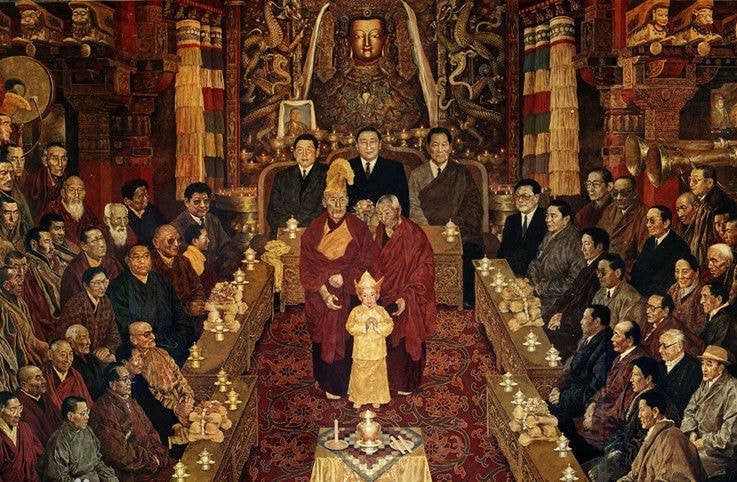
Why Does the Chinese Government Emphasize It So Much?
The core reason Beijing has elevated this system to an “uncrossable red line” lies in geopolitical control and the assertion of sovereignty:
Monopolizing Discourse Power: The Dalai Lama holds immense spiritual authority within Tibet and the international community. Controlling the mechanism of his reincarnation equates to controlling the future’s most influential spiritual leader.
Establishing Legal Precedent: Beijing seeks to emphasize rules imposed during the Qing Dynasty to claim that the central government’s “final authority” over the highest Tibetan religious figures has existed “since ancient times,” thereby codifying and historicalizing its governance over Tibet.
Eliminating External Influence: The absolute insistence on the Golden Urn Lottery is designed to completely eliminate any autonomy of the exiled Tibetan community and the current Dalai Lama in recognizing a successor.
However, if examined through the lens of religious purity, historical autonomy, and legal logic, the “Golden Urn” system has never possessed true legitimacy.
I. The Illusion of Religious Authenticity: Forcing Bureaucratic Techniques Upon Sacred Karma
A foundational pillar of Tibetan Buddhism is the concept of “karma, retribution, and the vows of Bodhisattvas.” A tulku can reincarnate because high lamas, armed with their own spiritual realization and immense compassion, consciously choose to return to the human realm to liberate sentient beings. Thus, the process of seeking a reincarnate child is essentially a “decryption” of advanced spiritual energy, relying on the predecessor’s final instructions, visions in sacred lakes (Lhamo La-tso), prophecies of protective deities, and the child’s innate recognition of past-life belongings.
The “Golden Urn Lottery,” however, brutally downgrades this search for sacred karma into a base game of chance.
Absurd Instrumental Rationality: Emperor Qianlong openly admitted that the inspiration for the “Golden Urn” came from the “drawing of lots” (qian fa) used to allocate government officials in the Ming and Qing secular bureaucracies. Applying a lottery technique—designed in the secular bureaucratic world for fair distribution and corruption prevention—to the recognition of a Bodhisattva’s manifestation is profoundly absurd in religious logic.
Erasure of the Sacred: When an ivory slip in a vessel becomes the sole metric for deciding a Dalai Lama, centuries of native Tibetan spiritual rituals are completely hollowed out. This is not only a profound disrespect to Buddhist practitioners but a brazen usurpation of the sacred realm by secular power.
II. The Refutation of Historical Practice: A Superficial “Political Facade”
If a system possesses genuine, deep-seated legitimacy, it should logically be respected and adhered to throughout history. Ironically, from its inception, the “Golden Urn Lottery” was collectively resisted and covertly marginalized by Tibetan monastic and secular elites.
Throughout history, whenever Tibetan high lamas discovered a universally recognized, highly spiritual child through traditional rituals, the first reaction of the Tibetan regency and major monasteries was almost always to apply for an exemption from the lottery.
Ironclad Historical Evidence: Among the generations of Dalai Lamas following the introduction of the “Golden Urn”:
- The 9th Dalai Lama (Lungtok Gyatso): Exempted from the lottery due to his undeniable and miraculous signs, directly ascending the throne.
- The 13th Dalai Lama (Thubten Gyatso): Similarly permitted an exemption because the traditional recognition was unequivocally clear.
- The 14th Dalai Lama: Also recognized and enthroned without undergoing the Golden Urn Lottery.
These crucial “historical exceptions” prove precisely that within the genuine religious tradition of Tibet, the Golden Urn never achieved foundational legitimacy. It functioned more as a “political facade”—a concession the Tibetan government was forced to make under the threat of imperial military force. Given any opportunity, the Tibetan monastic and secular public immediately reverted to true native traditions.
III. The Failure of Legality and Contract: An Imposed System Devoid of Cultural Consent
From the perspective of modern jurisprudence, the legitimacy of any major system concerning local governance or religious belief must be built upon the “consent of the governed” and cultural alignment.
A Product of Coercion: The “Golden Urn Lottery” was imposed upon Tibet through the 29-Article Ordinance for the More Efficient Governing of Tibet after the Qing government utilized its military superiority following the war against the invading Gurkhas. This was a top-down administrative decree backed by bayonet intimidation, not a contract arising from the spontaneous evolution or negotiated consent of the Tibetan religious community.
The Pretext of Anti-Corruption vs. The Essence of Centralization: The Qing court’s official justification for pushing this system was “preventing aristocratic monopolies over reincarnations” (i.e., the corruption of high lamas all emerging from a few elite families). While it is true that some aristocrats manipulated reincarnations at the time, this was an internal governance issue of the religious community. The secular empire used this as a pretext to seize the final authority over the highest religious figures and pull it back to Beijing. Its true goal was not to protect Buddhism, but to achieve geopolitical centralization and neutralize the spiritual core around which Tibetan resistance could coalesce.
Dust to the Urn, Spirit to the Faith
The “Golden Urn” is an exquisite political shackle. It uses yellow silk, ivory slips, and a golden vase to wrap itself in a posture of “respecting Buddhism,” while its interior is stuffed with the calculated schemes of secular rulers.
True legitimacy does not grow inside a golden urn carved with dragon motifs; it lives in the faith of the believers and the lineage of tradition. The more today’s Chinese government insists on the indispensability of the “Golden Urn Lottery,” the more it exposes its own deficit of legitimacy within the spiritual realm of Tibetan Buddhism. When a regime attempts to use secular lotteries and administrative approvals to dictate the path of a soul, it has already declared bankruptcy in both legality and sanctity. Power may temporarily suppress a ritual, but it can never bestow genuine spiritual legitimacy upon an imposed system.
The photos come from Google
Edited by Wilson & Clint