

Dzi beads are highly valued spiritual artifacts originating from Tibetan and Himalayan cultures. These beads are believed to carry powerful protective and healing energies. Often made from agate, they are decorated with symbolic patterns such as circles (eyes), waves, squares, or stripes. Each pattern holds specific meanings—for example, “three-eye” Dzi beads symbolize health, wealth, and longevity, while “nine-eye” beads are said to bring great power and success.
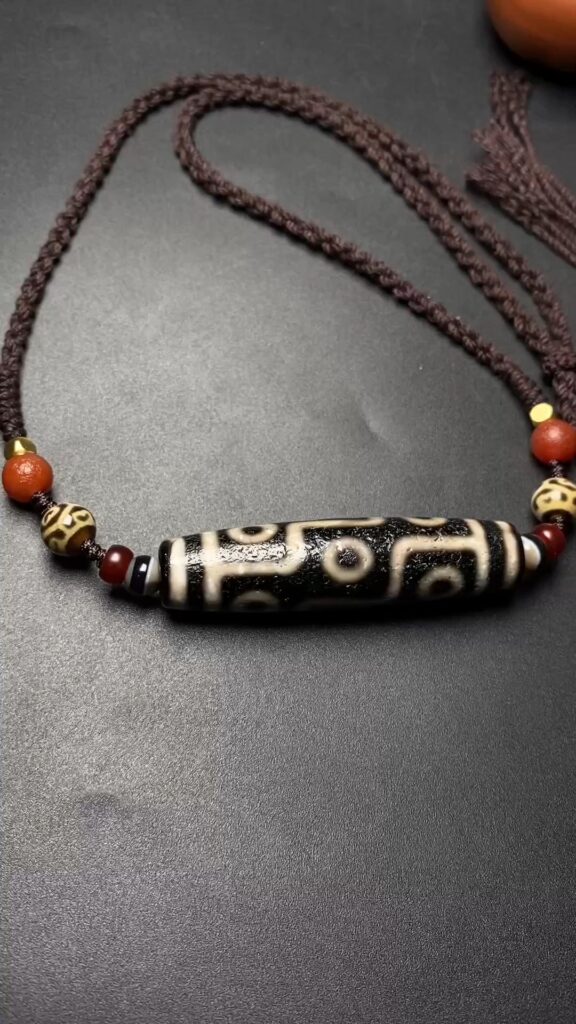
Traditionally, Dzi beads were passed down through generations and often regarded as sacred. They are worn as amulets or incorporated into prayer jewelry like malas (Buddhist rosaries). Their mysterious origins—some believed them to be heaven-sent—have only enhanced their spiritual reputation.
Due to their high value, many imitations exist. Here are some basic tips to distinguish authentic Dzi beads:

Material & Texture: Genuine Dzi beads are made from natural agate and often have a smooth yet aged texture. Their surface may show signs of natural wear, corrosion, or “blood spots” (red iron deposits).
Pattern Quality: Authentic patterns are usually etched or burned into the agate with mineral-based techniques and may not be perfectly symmetrical. Fakes often use modern printing or resin molds and appear too flawless.
Light Test: When held under a light, real agate beads often reveal natural layers and internal inclusions. Plastic or glass fakes may look too transparent or uniform.
Price & Provenance: Authentic ancient Dzi beads are extremely expensive. If the price is low or the origin is unclear, it is likely a reproduction.
Microscope or Expert Test: A jeweler’s loupe or microscope can help reveal natural grain and aging signs. For serious collectors, consulting with a Tibetan artifact expert or sending the bead for lab testing is the most reliable method.