
Preservation of Tibetan
Culture and Language
Painting Thangka
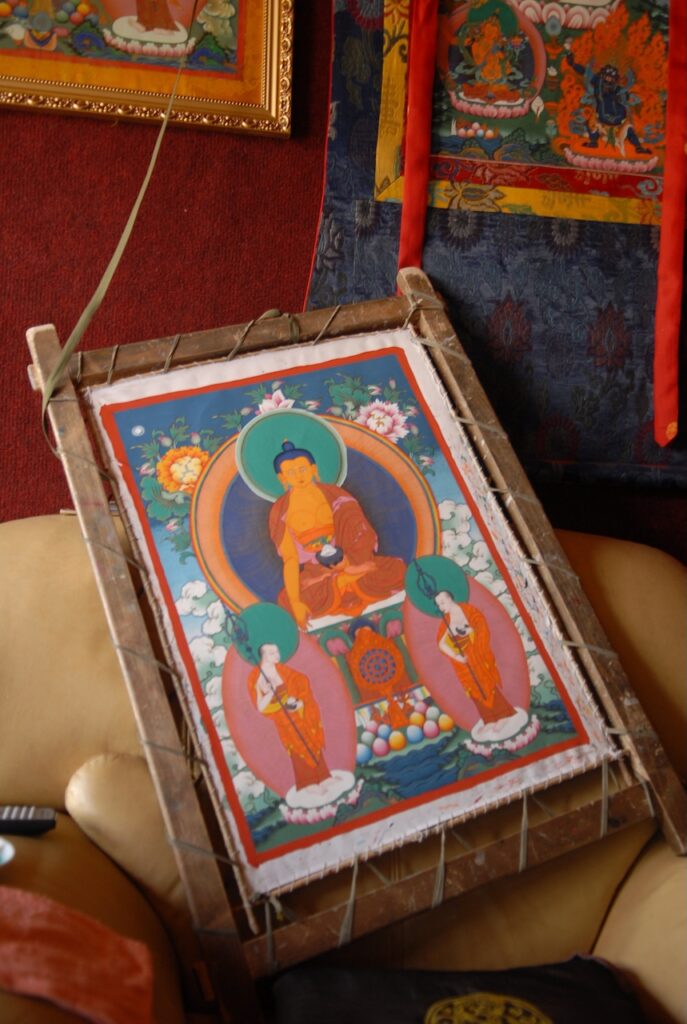
A thangka (Nepali pronunciation: [ˈt̪ʰaŋka]; Tibetan: ཐང་ཀ་; Nepal Bhasa: पौभा) is a Tibetan Buddhist painting on cotton, silk appliqué, usually depicting a Buddhist deity, scene, or mandala. Thangkas are traditionally kept unframed and rolled up when not on display, mounted on a textile backing somewhat in the style of Chinese scroll paintings, with a further silk cover on the front. So treated, thangkas can last a long time, but because of their delicate nature, they have to be kept in dry places where moisture will not affect the quality of the silk. Most thangkas are relatively small, comparable in size to a Western half-length portrait, but some are extremely large, several metres in each dimension; these were designed to be displayed, typically for very brief periods on a monastery wall, as part of religious festivals. Most thangkas were intended for personal meditation or instruction of monastic students. They often have elaborate compositions including many very small figures. A central deity is often surrounded by other identified figures in a symmetrical composition. Narrative scenes are less common, but do appear.
Thangka serve as important teaching tools depicting the life of the Buddha, various influential lamas and other deities and bodhisattvas. One subject is the Wheel of Life (Bhavachakra), which is a visual representation of the Abhidharma teachings (Art of Enlightenment). The term may sometimes be used of works in other media than painting, including reliefs in metal and woodblock prints. Today, printed reproductions at poster size of painted thangka are commonly used for devotional as well as decorative purposes. Many thangkas were produced in sets, though they have often subsequently become separated.
Tibetan Buddhist painting developed from widespread traditions of early Buddhist paintings which now only survive in a few sites such as the Ajanta Caves in India and the Mogao Caves in China, which have very extensive wall-paintings and were the repository for what are now the earliest surviving Tibetan paintings on cloth. The thanka form developed alongside the tradition of Tibetan Buddhist wall paintings, which are or were mostly in monasteries.
The early history of the form is more easily traced through these murals, which survive in greater numbers than the portable paintings which certainly once existed. The art form originating from the Newari art of Phauba from Nepal, from the early years artists were commissioned from Nepal, furthermore, ancient texts have been found wherein instructions were provided as to the proportions, postures and geometrical measurements of these deities to the monasteries from Nepal. Most thanka were commissioned by individuals, who were believed to acquire merit by doing so. They might then be given to a monastery or another individual, or retained for use by the commissioner. Some thangka have inscriptions on their back recording that they were the personal meditation image (thugs dam) of a notable monk. Most artists were probably monks, although lay artists seem to have also existed, as they did for metalwork sculpture. The commissioner would provide the materials, which were often valuable, and by tradition the compensation to the artist was regarded as a “gift” rather than a fee. The word “thangka” means “thing that one unrolls” in Classical Tibetan. Thangka are very rarely signed, but some artists are known, more because they were important monastic leaders than famous as artists. Painting was a valued accomplishment in a monk.
The earliest surviving Tibetan paintings on cloth are from the Mogao Caves at Dunhuang on the Silk Road in Gansu province, China. The “Library Cave” there was a repository of old or worn out manuscripts, paintings, prints, textiles and other items which was sealed off in the 11th century, after several centuries of deposits. Many of the paintings have Tibetan inscriptions or are in a style that can be recognized as Tibetan, as opposed to the dominant Han Chinese style and some pieces reflecting Indian styles. Though they are hard to date, it is thought that these pieces mainly come from a period c. 781–848 during Tang dynasty rule.
Surviving tangkas on cloth certainly from Tibet itself start in the 11th century, after the revival of Buddhism; there are some 20 surviving from the 11th and 12th century. Such early examples typically have compositions that are already complex, but less so than in later examples. Later the typical compositions show a central figure flanked by smaller figures, often in framed compartments, or surrounded by flaming halos or seated on small clouds. Behind these figures a landscape background including much sky is often indicated, though little of it may be visible. The central figure may be a deity, arhat, or important monk, and the same groups make up the background figures. Several of the figures may be different “aspects” or reincarnations of each other according to Buddhist theology. In the example at left the flanking bodhisattvas are in a style, one of several found in such figures in this period, that appears derived from central Indian art.
Over the following centuries Tibetan painting, both on walls and thangka, continued to develop in its distinctive style, balancing between the two major influences of Indo-Nepalese and Han Chinese painting, despite Buddhism being on the general decline in these regions. Styles could vary considerably between the different regions of Tibet, as well as the wider region where tangkas were painted. Within Tibet the regions nearer Nepal and the rest of China were often more influenced by regional styles. Bhutanese tangkas were mainly influenced by Central Tibet. The different monastic orders also developed somewhat different stylistic characters.
Tibetan painting incorporated many elements from Han Chinese painting, especially from the 14th century onwards, reaching a peak in the 18th century. One aspect of this was allowing more space and emphasis to the landscape background. In general the style of figures in thangkas remains derived from the Indo-Nepalese tradition. According to Giuseppe Tucci, by the time of the Qing dynasty, “a new Tibetan art was then developed, which in a certain sense was a provincial echo of the Chinese 18th century’s smooth ornate preciosity.” Since the Yuan dynasty, Tibet was administered as part of China, but when the Qing dynastycame to power court interest in Tibetan Buddhism increased, and many refined and elegant works were produced by Imperial artists and sent to Tibet, influencing local styles. As well as the court style, there was influence from the regions of China near Tibet.
Tangkas were painted in all the areas where Tibetan Buddhism flourished, which apart from those mentioned already included Mongolia, Ladakh, Sikkim, and parts of Himalayan India in Arunachal Pradesh, Dharamshala, and Lahaul and Spiti district in Himachal Pradesh. It is also practiced in parts of Russia (Kalmykia, Buryatia, and Tuva) and Northeast China.
Other traditions of Buddhist scroll paintings are not usually covered by the term thangka, although they may have many similarities, and descend from the same origins. An example is Japanese painting, where a number of very early examples survive from the Nara (710–794) and Heian periods (794 to 1185). Most of these are National Treasures of Japan. Raigō-zu developed as one popular genre, showing the Amida Buddha accompanied by bodhisattvas welcoming the souls of the faithful to his Western Paradise. These were, and still are, carried into the house of a person who was near death.
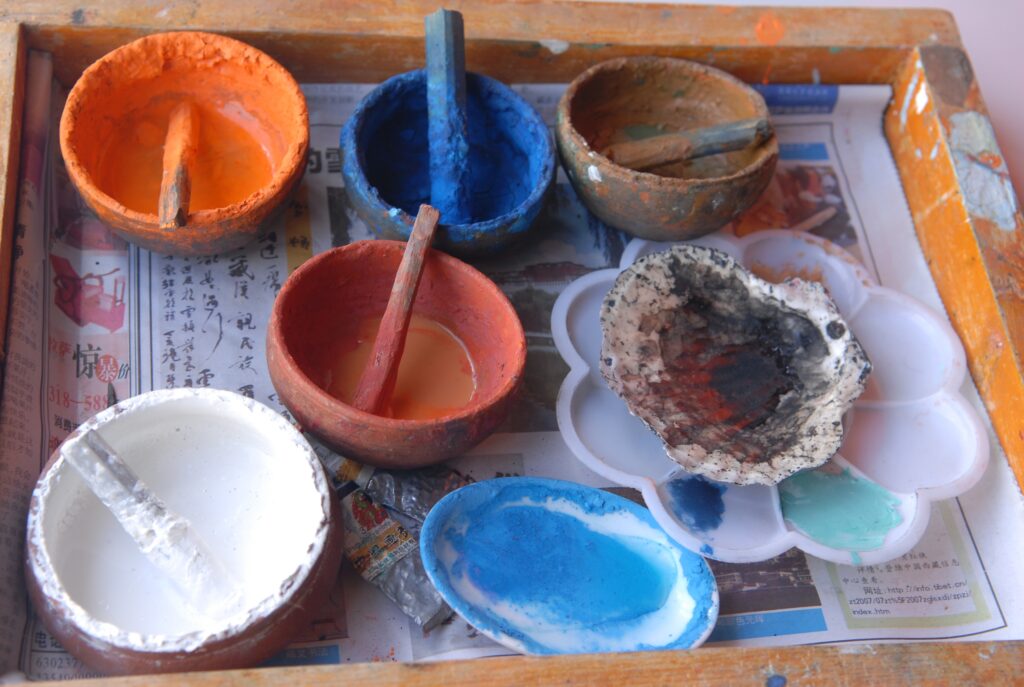
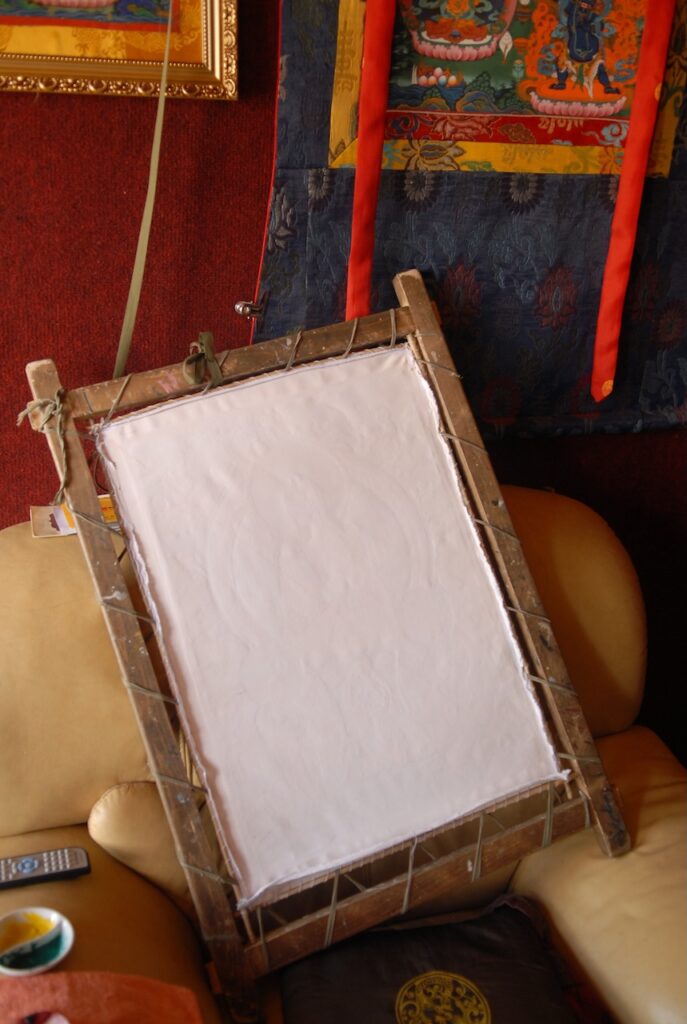
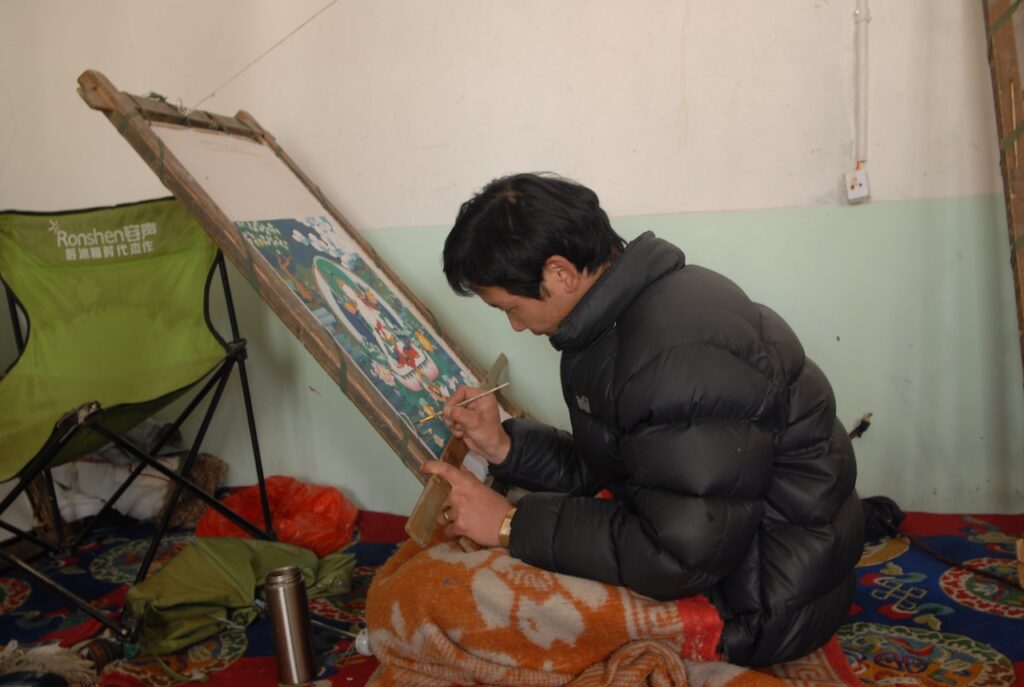
Thangkas are painted on cotton or silk. The most common is a loosely woven cotton produced in widths from 40 to 58 cm (16 to 23 in). While some variations do exist, tangkas wider than 45 cm (17 or 18 inches) frequently have seams in the support. The paint consists of pigments in a water-soluble medium of animal glue. Both mineral and organic pigments are used. In Western terminology, this is a distemper technique; although it is often described as a form of gouache, this is incorrect, and the paint was applied as a warm liquid, mixed shortly before application. In Nepal, 24 carat gold is also plated over some parts of thangka paintings which makes the art a little more expensive.
The Role of Natural Pigments: Thangka paintings traditionally utilize natural pigments sourced from minerals, plants, and even precious stones. These pigments not only lend vibrant colors but also hold symbolic significance. For example, gold symbolizes enlightenment, lapis lazuli represents the sky, and cinnabar signifies vitality. Understanding the symbolism behind these pigments adds depth to the appreciation of Thangka art. Sacred Geometry and Proportions: Thangka paintings are not merely artistic expressions but also embody spiritual principles and sacred geometry. The precise measurements and proportions used in creating Thangkas are based on ancient mathematical and philosophical concepts, such as the golden ratio and mandala symbolism. This aspect reflects the harmony between art and spirituality in Tibetan culture. The Ritual of Thangka Creation: Creating a Thangka is not just a creative process but also a spiritual practice. Artists often undergo rigorous training and follow specific rituals before, during, and after painting a Thangka. These rituals involve purification ceremonies, chanting mantras, and invoking blessings from spiritual masters. This imbues each Thangka with a sacred energy that resonates with those who view or meditate upon it. The Living Tradition of Thangka Painting: While Thangka paintings have a rich history dating back centuries, the tradition is very much alive today. Contemporary Thangka artists are not only preserving ancient techniques but also innovating with new styles and interpretations. Some artists blend traditional Tibetan motifs with modern artistic influences, creating unique expressions that appeal to a global audience. Empowering Communities Through Thangka Art: Beyond their aesthetic and spiritual value, Thangka paintings play a significant role in empowering communities in the Himalayan region. Many Thangka painting schools and cooperatives provide training and employment opportunities for local artists, particularly in rural areas. By supporting Thangka art, buyers contribute to the preservation of Tibetan culture and the livelihoods of Himalayan communities.
Most old thangka have inscriptions on the back, usually the mantra of the deity depicted, but sometimes also information as to later owners, though rarely information about the original commissioner or artist. Sometimes x-rays allow pious inscriptions placed under the paint on the front of the image to be seen. Inscriptions may be made in the shape of a stupa, or sometimes other shapes.
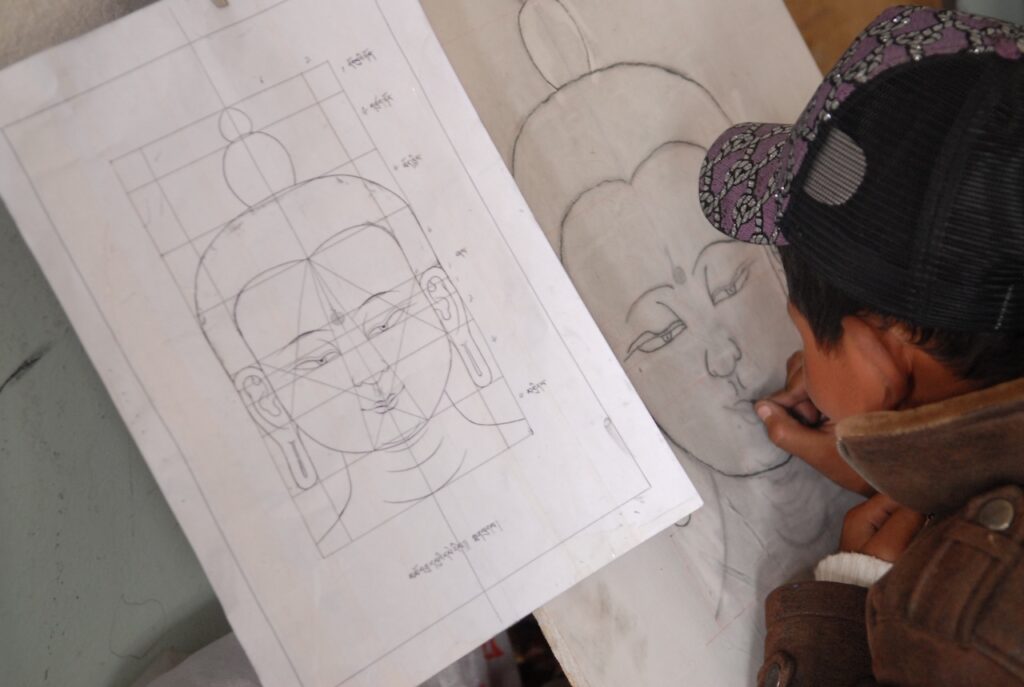
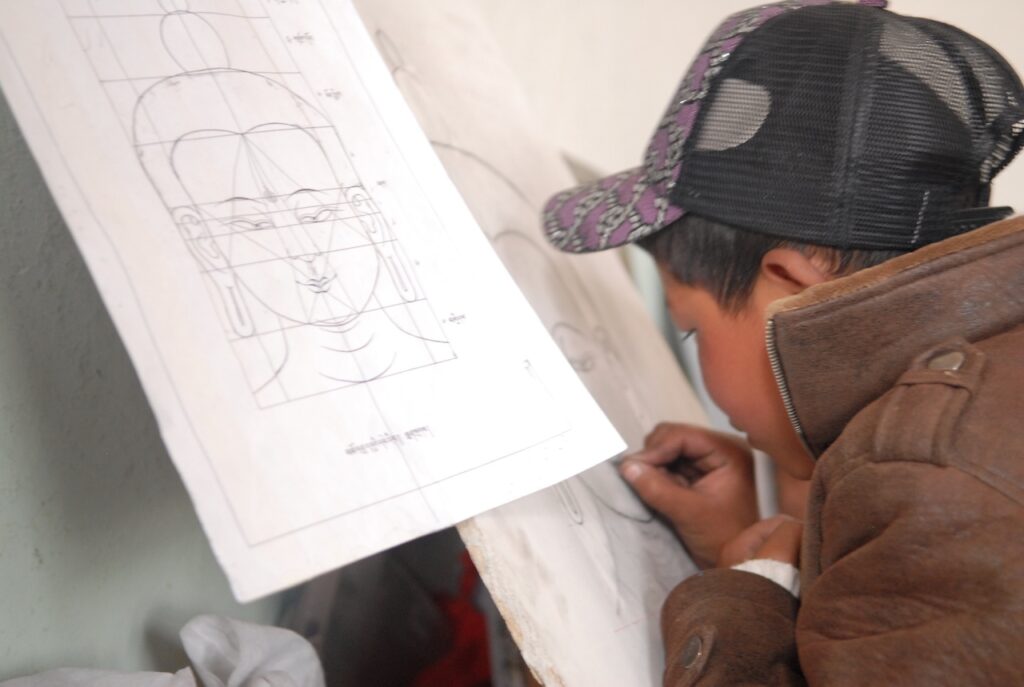
The composition of a thangka, as with the majority of Buddhist art, is highly geometric. Arms, legs, eyes, nostrils, ears, and various ritual implements are all laid out on a systematic grid of angles and intersecting lines. A skilled thangka artist will generally select from a variety of predesigned items to include in the composition, ranging from alms bowls and animals, to the shape, size, and angle of a figure’s eyes, nose, and lips. The process seems very methodical, but often requires deep understanding of the symbolism involved to capture the spirit of it.
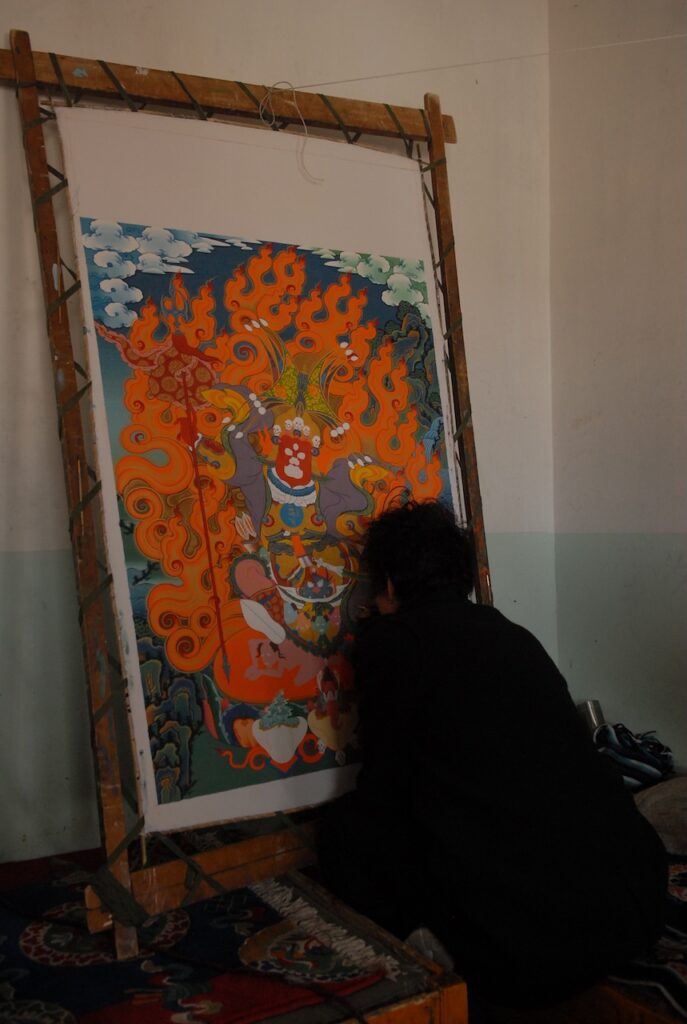
Thangka often overflow with symbolism and allusion. Because the art is explicitly religious, all symbols and allusions must be in accordance with strict guidelines laid out in Buddhist scripture. The artist must be properly trained and have sufficient religious understanding, knowledge, and background to create an accurate and appropriate thangka:
Tibetan art exemplifies the nirmanakaya, the physical body of Buddha, and also the qualities of the Buddha, perhaps in the form of a deity. Art objects, therefore, must follow rules specified in the Buddhist scriptures regarding proportions, shape, color, stance, hand positions, and attributes in order to personify correctly the Buddha or Deities.
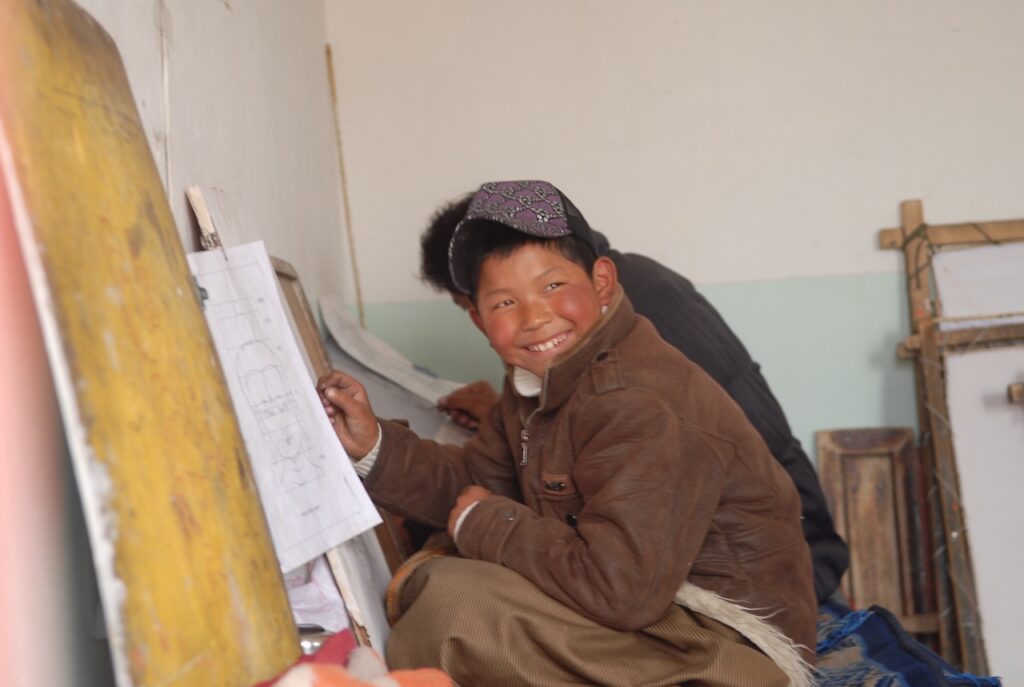
The introduction text comes from Wiki
Photo By Clint & Wilson
