

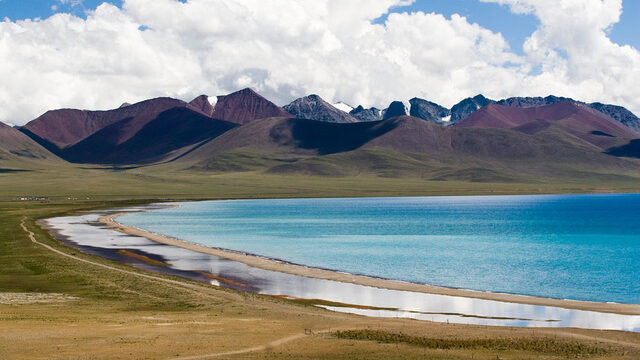
Namtso or Lake Nam (officially: Namco; Mongolian: Tenger nuur; Chinese: 纳木错; pinyin: Nàmù Cuò; Tibetan: གནམ་མཚོ་, ZYPY: Nam Co; “Heavenly Lake” in European literature: Tengri Nor, 30°42′N 90°33′E) is a mountain lake on the border between Damxung County of Lhasa prefecture-level city and Baingoin County of Nagqu Prefecture in the Tibet Autonomous Region of China, approximately 112 kilometres (70 mi) NNW of Lhasa.
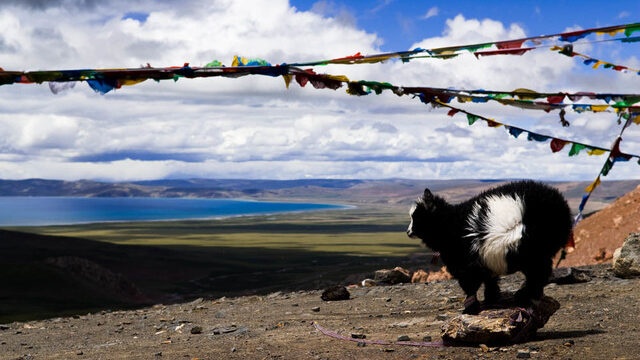
Namtso (Namco) is a lake that first formed during the Paleogene age, as a result of Himalayan tectonic plate movements. The lake lies at an elevation of 4,718 m (15,479 ft), and has a surface area of 1,900 km2 (730 sq mi).This salt lake is the largest lake in the Tibet Autonomous Region. However, it is not the largest lake on the Qinghai-Tibet Plateau. That title belongs to Qinghai Lake (more than twice the size of Namtso); which lies more than 1,000 km (620 mi) to the north-east in Qinghai
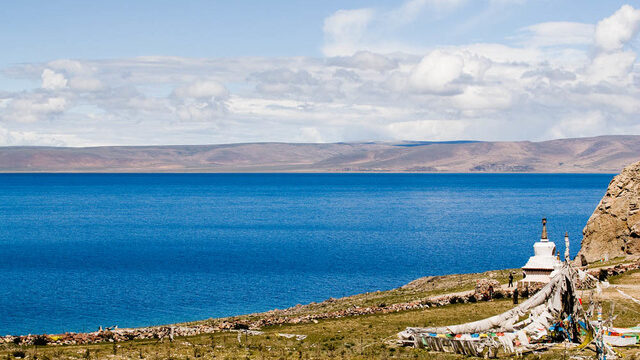
Namtso has five uninhabited islands of reasonable size, in addition to one or two rocky outcrops. The islands have been used for spiritual retreat by pilgrims who walk over the lake’s frozen surface at the end of winter, carrying their food with them. They spend the summer there, unable to return to shore again until the water freezes the following winter. This practice is no longer permitted by Chinese authorities.
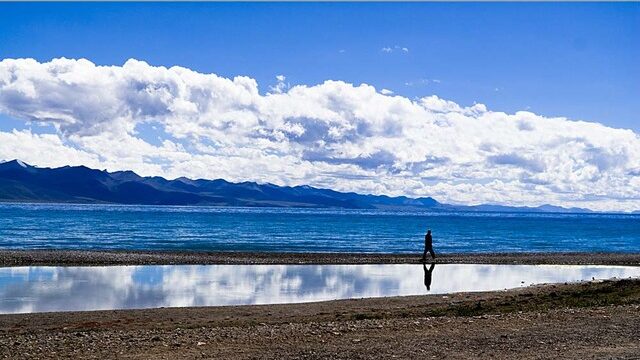
The largest of the islands is in the northwest corner of the lake, and is about 2,100 m (6,900 ft) long and 800 m (2,600 ft) wide, rising to just over 100 m (330 ft) in the middle. At its closest point it is about 3.1 km (1.9 mi) from the shore.
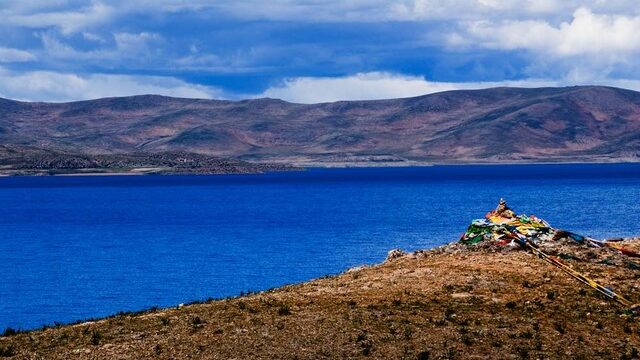
The weather at Namtso is subject to abrupt, sudden change and snowstorms are very common across the Nyainqêntanglha range.Namtso has a Köppen climate classification of alpine or tundra climate (Koppen ET).

The introduction text comes from Wiki
Photo By Clint & Wilson